MoonPay Buys an AI Accountant, Toss Bank Picks Solana and GCash Files for a Billion-Dollar IPO

Three stories from the past week capture three of fintech’s most consequential vectors at the same time. A crypto payments leader is buying AI accounting agents to bring the back office up to the speed of stablecoin payments. One of South Korea’s biggest internet-only banks is stepping onto a public blockchain to rebuild cross-border remittances. And in the Philippines, the company behind one of Asia’s most successful super-apps is preparing what could be the country’s largest-ever IPO. Here is what is happening, and why it matters for merchants, partners and financial institutions.
MoonPay Acquires Entendre to Automate Stablecoin Finance Operations

On 22 June, MoonPay, the global crypto payments network, announced the acquisition of Entendre, an AI-native finance operations platform built for companies that move and manage money on-chain. Founder Kareem Khattab joins MoonPay as Vice President of Applied AI, with the full Entendre team coming over immediately. Financial terms were not disclosed. The acquisition extends MoonPay’s infrastructure beyond payments, custody and trading into reconciliation, treasury and financial close workflows for businesses operating in the stablecoin economy, and is the company’s third major acquisition of 2026 after Sodot in April and the Decent and DFlow deal in May.
The numbers behind Entendre are telling. Its customers, which include Polygon Labs, Thirdweb, Brale, Babylon Labs, Ostium, Courtyard and DoubleZero, manage on average more than 30 financial accounts, process around 25,000 transactions per month and operate across three or more legal entities. Teams using the platform automate roughly 93 percent of journal entries, cut manual accounting work by more than half, and close their books three times faster. The platform integrates with general ledgers including NetSuite, QuickBooks, Xero, DualEntry and Campfire; spend and revenue tools like Ramp and Stripe; digital-asset infrastructure providers such as Rain, Meow and Slash; and workplace tools including Slack and Gmail. It also supports MCP servers, letting companies extend accounting agents into custom tools and data sources. MoonPay’s CEO Ivan Soto-Wright framed the deal directly: “if businesses are going to adopt stablecoins at scale, their finance operations need the same speed, context and automation as the payments themselves.”
Why it matters: Stablecoin transaction volumes have outrun the back-office tools that record them, particularly for global-from-day-one businesses operating across multiple wallets, ledgers and entities. Bringing AI agents into accounting closes that gap and turns finance operations from a recurring bottleneck into a real-time discipline. Expect more deals at this seam between payment infrastructure and finance operations, and expect AI agents to become a standard layer behind any serious stablecoin business.
The Debia angle: The most useful read on this deal is structural. Payments and back-office workflows are converging into a single, automated stack, and the winners in the next phase of fintech will be the providers who orchestrate both layers cleanly for merchants and partners. That principle, treat payments and the operational fabric around them as one product, is exactly how Debia thinks about its role in payment infrastructure for the businesses we serve.
Toss Bank Signs a Solana MoU to Pilot Blockchain Remittances
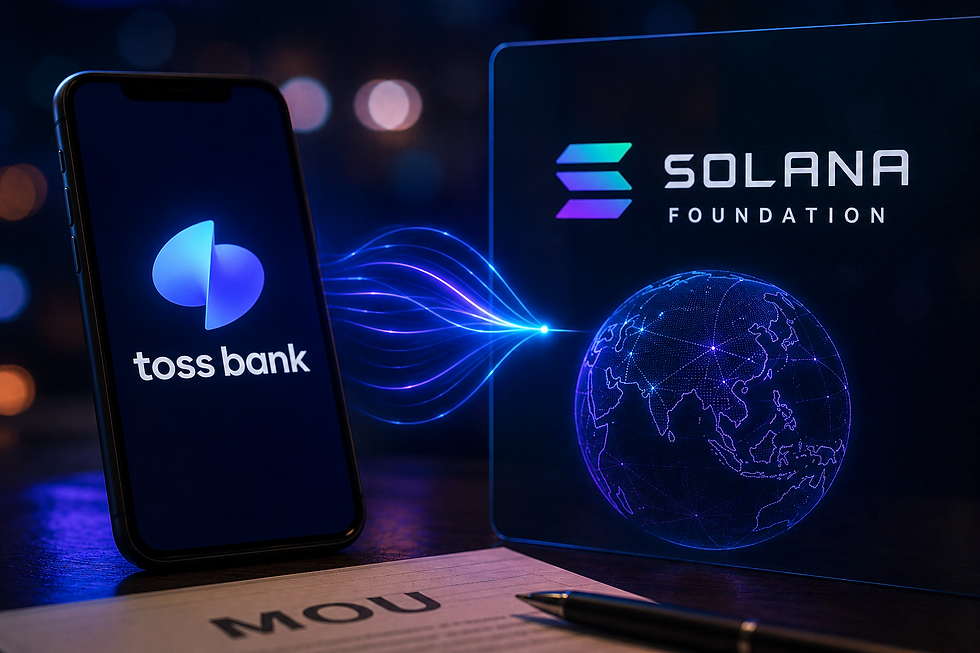
Also on 22 June, the Solana Foundation and South Korea’s Toss Bank publicly announced a Memorandum of Understanding signed in Seoul on 19 June. Toss Bank, the country’s third-largest internet-only bank with around 15 million customers, described the deal as the first direct one-to-one strategic partnership between a South Korean internet-only bank and the Solana Foundation. The agreement covers four areas: a proof of concept for global remittance and settlement infrastructure built on Solana, joint research into blockchain-based payment and settlement models, exploration of stablecoin and tokenised real-world asset financial services, and a longer-term cooperation framework that includes integration with overseas banking partners and AML and KYC compliance.
The first deliverable is the cross-border remittance PoC, designed to test whether stablecoin transfers on Solana can fit into existing remittance workflows without compromising compliance, settlement or consumer protection. Toss Bank already runs an overseas remittance service across 30 countries and 7 major currencies, giving the pilot a non-trivial addressable base from day one. The strategic backdrop matters too. Toss’s parent Viva Republica is preparing a US IPO in 2026 targeting a valuation above 10 billion dollars, potentially closer to 15 billion, with backers including Singapore’s GIC, Sequoia and Kleiner Perkins. South Korea also plans to bring cross-border crypto transfers under formal foreign-exchange oversight from December 2026, making this an unusually deliberate move to position licensed, compliance-integrated stablecoin remittances ahead of the regime change.
Why it matters: This is one of the clearest examples to date of a major Asian digital bank publicly anchoring part of its product roadmap to a public blockchain. If the PoC delivers, Solana gains a meaningful institutional reference customer in Asia and Toss Bank gains a faster, cheaper international transfer product for 15 million customers. Expect more APAC digital banks to test similar architectures as regulators in Korea, Hong Kong, Singapore and beyond formalise their stablecoin and crypto regimes.
The Debia angle: Our consistent view is that the future of cross-border payments is interoperability between traditional rails and compliant blockchain infrastructure, with the customer experience kept simple inside familiar banking flows. Toss Bank’s approach is exactly that thesis playing out in a major APAC market. The lesson for any payments business is the same. The orchestration that lets a customer move money from a bank account to a wallet, across borders and currencies, without ever having to learn a new stack, is where the value increasingly sits.
GCash Parent Mynt Files for What Could Be the Philippines' Largest IPO

In ASEAN, Mynt, the Philippine fintech company behind the GCash finance super-app, announced on 17 June that its board and shareholders have authorised the filing of a registration statement with the Securities and Exchange Commission and a listing application with the Philippine Stock Exchange. The offer is set at 12 percent of total outstanding shares post-IPO and will include both primary and secondary shares. Mynt has not formally disclosed valuation or fundraising targets, but the company has previously signalled an 8 billion dollar valuation and reporting from the Wall Street Journal suggests the IPO could raise around 1 billion dollars. If it lands at that scale, it would overtake Monde Nissin’s 2021 listing as the largest IPO in Philippine history.
The business behind the listing is now one of the most consequential consumer fintechs in Southeast Asia. GCash, which started as an SMS-based remittance service in 2004, today serves around 94 million users across payments, lending, savings, investments and insurance, and contributed roughly 30 percent of parent Globe Telecom’s first-quarter pre-tax earnings. Mynt is backed by a heavy-hitting investor base that includes Globe Telecom and Ayala Corp, China’s Ant Group and Japan’s Mitsubishi UFJ Financial Group. Regulators have also calibrated the listing rules around it. The Philippine SEC and PSE lowered the minimum free float requirement to 12 percent for exceptionally large listings earlier this year, partly to enable transactions of this scale. The listing is expected in the second half of 2026, with reports suggesting Q4 as the likely window.
Why it matters: ASEAN’s super-app generation is moving from private growth story to public markets test. A successful Mynt listing would give the Philippine equity market its first true large-scale technology benchmark, give the region’s broader fintech ecosystem a credible IPO playbook, and put real public market discipline behind a business that already serves close to half the country’s population. Expect more Southeast Asian fintech and super-app names to revisit IPO plans on the back of this transaction.
The Debia angle: The most useful signal in this story is what it says about durable infrastructure. GCash got here by becoming the default rail for digital payments, lending and financial inclusion in the Philippines, and by partnering rather than competing with the country’s biggest telco, banks and global investors. That blueprint, dominant local rails plus deep regional partnerships, is exactly what Debia is built around for the businesses we serve across the region. ASEAN’s next decade in fintech will be defined by infrastructure that scales quietly underneath very public super-app brands.
At Debia, we track these changes because the future of payments will be shaped by speed, trust, interoperability, and smarter financial infrastructure. We do not just process payments. We understand the infrastructure, regulation, technology, and market shifts behind the future of digital commerce, and we build for where the ecosystem is heading next.


Comments