From a Social App to a Restaurant Platform to a QR Code: Payments Keeps Closing the Gaps
- Pedro Garcia

- 16 hours ago
- 4 min read
X Money finally launches nationwide, turning X into a real financial platform
On 27 July, Elon Musk's X began a nationwide rollout of X Money to Premium and Premium+ subscribers across the United States, following a limited beta that started earlier in the summer with a small group of verified users. First announced in 2023 and delayed repeatedly since, the launch gives eligible users an X-branded Visa debit card, available in both virtual and physical metal formats, that can be added instantly to Apple Pay and used for fee-free, real-time peer-to-peer transfers within the app. The underlying accounts are FDIC-insured up to 250,000 dollars through banking partner Cross River Bank, since X itself does not hold a bank charter. Premium+ subscribers, who pay 40 dollars a month or 395 dollars a year, receive up to 6 percent annual yield on deposits by default, while Premium subscribers at 8 dollars a month can access the same rate by linking a direct deposit. The card also carries 3 percent cashback on eligible purchases, free worldwide ATM withdrawals and no foreign transaction fees, protected under Visa's standard fraud and zero-liability policies.
Beyond peer-to-peer transfers, X Money supports linking external bank accounts, receiving direct deposits, paying bills and general account management, positioning it as a direct competitor to Venmo, Cash App and Zelle, but with the distinct advantage of sitting inside a social network with an existing user base rather than requiring a separate download. Security is built around passkey authentication rather than passwords alone, with configurable spending limits and additional verification available for certain transactions. Musk's ambitions for X Money trace back to his original X.com online banking venture from 1999, which later merged into what became PayPal; turning X into a financial “everything app” along the lines of China's WeChat has been a stated goal of his since acquiring Twitter. The company has not yet confirmed international expansion plans.

Adyen follows Toast into the US, its biggest and most contested market yet
On 10 August, Amsterdam-based Adyen announced it is expanding its five-year partnership with Toast, the restaurant and hospitality technology platform, into the United States for the first time. Adyen has supported Toast's international expansion since 2021 across Ireland, the UK, Canada and Australia, providing a single payments processing solution as the company scaled beyond its US home base. Toast itself is a significant operation: over the twelve months ending 30 June 2026, the platform facilitated more than 215 billion dollars in gross payment volume across approximately 180,000 locations worldwide, spanning independent restaurants, multi-location chains and large hospitality brands. Under the expanded agreement, Adyen becomes part of Toast's US payments ecosystem for the first time, adding processor redundancy in a market where Toast has historically relied on a narrower set of processing partners.
Adyen frames the expansion as a natural extension of its unified, in-house financial technology model, which combines payments, issuing, working capital and business accounts into a single system rather than stitching together multiple vendors. “Businesses need technology that helps them stay competitive, not systems that slow them down,” said Blake Breathitt, Adyen's SVP and Global Co-Head of Strategy. Toast's General Manager of Fintech, Michel Rbeiz, described Adyen as “a cornerstone of how we deliver reliable, scalable payments services across international markets,” calling the US addition “a natural expansion of that relationship.” The move follows Adyen's June launch of Adyen Agentic, aimed at helping merchants adopt agentic commerce, and comes as Toast separately became one of the first point-of-sale providers to integrate with Google's Ask Maps platform for AI-driven food ordering.

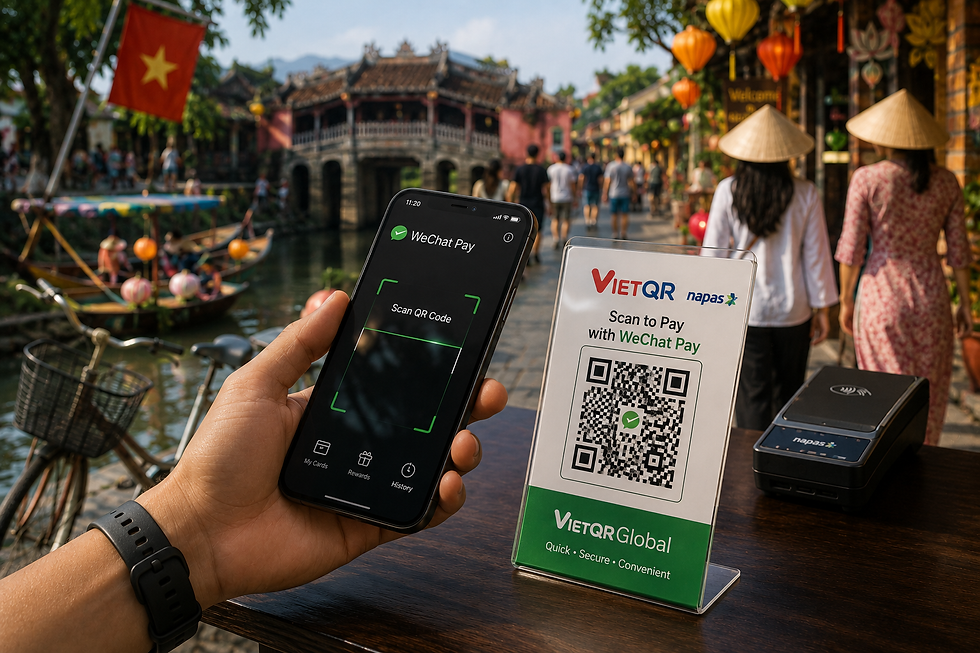
Vietnam's NAPAS connects to Weixin Pay, opening VietQRGlobal to over a billion users
On 6 August, Vietnam's National Payment Corporation (NAPAS), the Bank for Investment and Development of Vietnam (BIDV) and Weixin Pay, also known as WeChat Pay, held a ceremony in Hanoi announcing the expansion of cross-border QR payment connectivity between Vietnam and China. The connection lets Weixin Pay's more than one billion users in China scan VietQRGlobal codes to pay directly at retail stores, restaurants, hotels, accommodation providers and tourist attractions across Vietnam, with BIDV serving as the settlement bank for transactions processed through the link. Weixin Pay becomes the third Chinese payment platform to complete cross-border QR connectivity with NAPAS during 2026, following earlier integrations with UnionPay International and Alipay, effectively completing NAPAS's QR interoperability coverage across China's three largest mobile payment platforms.
The timing reflects Vietnam's growing reliance on Chinese tourism and trade. According to Pham Anh Tuan, Director of the Payment Department at the State Bank of Vietnam, the country welcomed approximately 12.3 million international visitors in the first six months of 2026, up nearly 15 percent year on year, with China remaining the largest single source market at roughly 2.7 million visitors, or about 22 percent of total arrivals. “Expanding cross-border QR payment connectivity with Weixin Pay is a significant milestone in the development and expansion of Vietnam's digital payment infrastructure's international connectivity,” said Nguyen Quang Minh, NAPAS's General Director, adding that the connection “completes the QR payment interoperability to serve the payment needs of Chinese tourists in Vietnam, while expanding VietQRGlobal's reach to the world's largest market of users and tourists.” BIDV General Director Hoang Viet Hung said the expanded service would give travellers a more convenient payment option while helping connect the two economies through modern financial infrastructure.


Comments