France Completes Its First Live Agentic Payment, SBI Acquires Bitbank and Indonesia Goes Live with China QR

Three stories from the past two weeks show agentic commerce, crypto consolidation and cross-border payment connectivity all maturing from pilot to production on three different continents. In France, an AI agent completed a live purchase entirely inside existing banking infrastructure. In Japan, SBI Holdings placed its biggest bet yet on crypto exchange consolidation ahead of tighter regulation. And between Indonesia and China, a QR payment corridor built over a year of sandbox testing has gone live. Here is what is happening, and why it matters for merchants, partners and financial institutions.
Worldline and Mastercard Complete France's First Live Agentic Payment
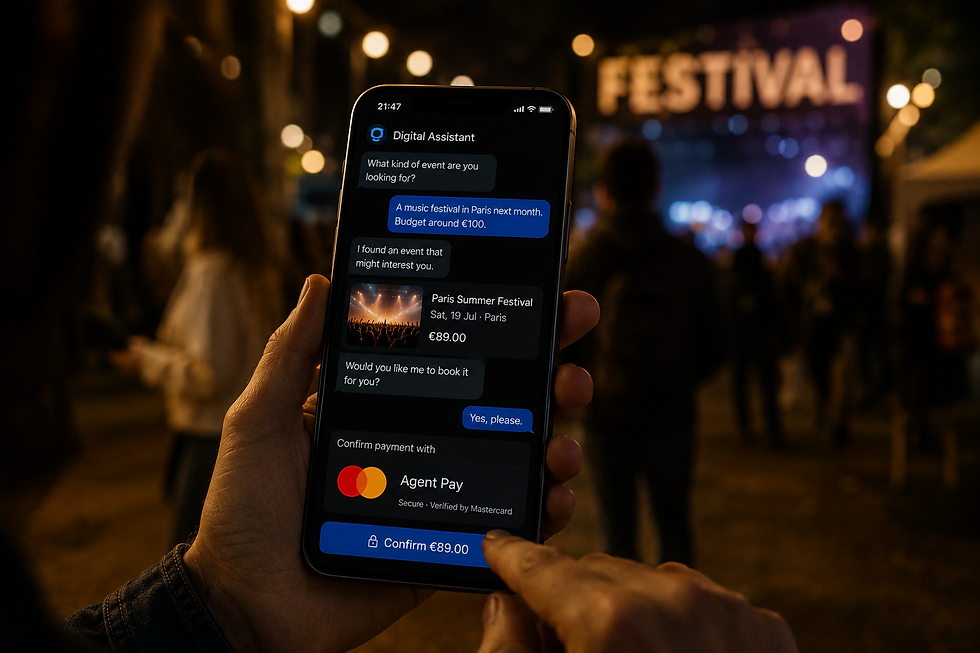
On 25 June, Worldline, Crédit Agricole and Mastercard announced they had completed France's first agentic payment transaction in a live production environment, not a pilot or demo. In the use case, a Crédit Agricole customer initiated a search for festival tickets through a digital agent by specifying budget, event type and location. The agent returned a matching selection from ticketing platform Weezevent, the customer reviewed and confirmed their choice, then instructed the agent to begin the purchase using Mastercard's Agent Pay framework. The transaction was only executed after the customer's explicit confirmation, keeping purchasing authority with the cardholder rather than the AI agent itself.
Crédit Agricole retained its traditional role throughout as the issuing bank, handling authentication and authorisation, with dedicated transaction identifiers applied to ensure full transparency and traceability across the payment chain. The entire commerce flow was processed end to end on Worldline's infrastructure while interacting with the Mastercard network. Madalena Cascais Tomé of Worldline's Executive Committee said the transaction demonstrates the company's ability to orchestrate the full ecosystem of merchants, banks and payment networks for agentic commerce, while Mastercard France's Barbara Sessa framed it as helping structure a robust, scalable framework for large-scale deployment across France and Europe. The milestone follows a similar live agentic transaction completed weeks earlier by ING, Worldline and Mastercard, suggesting European banks and payment networks are building a genuine production track record for AI-initiated purchasing rather than isolated proofs of concept.
Why it matters: This is one of the clearest signals yet that agentic commerce is moving out of the demo stage and into live banking infrastructure, with existing authentication, authorisation and compliance controls intact. The explicit-confirmation design, where the AI agent discovers and proposes but the human still authorises, looks likely to become the template regulators and card networks converge on. Expect more major European banks to run similar live agentic transactions over the next few months, and expect the conversation to shift from whether agentic commerce works to how quickly it scales across merchant categories.
The Debia angle: This is exactly the model Debia believes in: AI agents as visible, governed participants inside existing payment rails, not as a separate system bolted on top. The Worldline, Crédit Agricole and Mastercard transaction shows that agentic commerce does not require rebuilding payment infrastructure from scratch, it requires orchestrating the pieces that already exist, cleanly and with traceability preserved end to end. For merchants and partners, the practical lesson is to make sure payment infrastructure is ready to authenticate and authorise an AI agent's request exactly as it would a human's, well before agentic commerce becomes mainstream.
SBI Holdings Acquires Bitbank for $289 Million
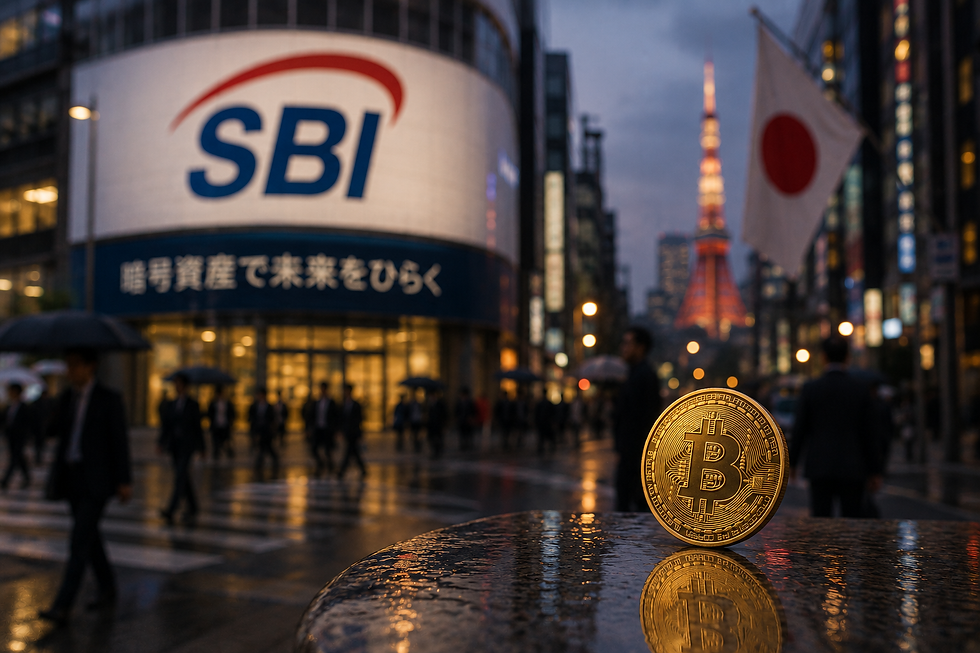
SBI Holdings, the Tokyo-based financial services group with a market capitalisation of around 11 billion dollars, agreed in late June to acquire Japanese cryptocurrency exchange Bitbank in a deal worth roughly 46.7 billion yen, or about 289 million dollars, its largest crypto consolidation move to date. Bitbank is one of Japan's longest-running licensed exchanges, founded in 2014, offering spot trading and lending across more than 40 digital assets and maintaining a record of zero customer asset losses from hacking since launch. Under the deal structure, SBI's subsidiary will purchase shares from Bitbank's founder and individual shareholders starting in August, with Bitbank then buying out corporate shareholders Mixi and Ceres by the end of October, completing full ownership transfer subject to Japan Fair Trade Commission approval.
The acquisition adds close to a million customer accounts and roughly 570 billion yen in custody assets, pushing SBI's combined crypto holdings above 1.1 trillion yen (about 6.8 billion dollars) across some 2.9 million accounts, making it Japan's largest crypto asset group by both custody and account count. Investment bank Architect Partners noted that SBI is paying roughly eight times Bitbank's revenue for an exchange that posted an operating loss last year, arguing the price only makes sense as a purchase of regulated market position rather than near-term profitability. The timing lines up with legislation passed by Japan's lower house on 11 June that would move crypto assets under the Financial Instruments and Exchange Act, the same framework covering stocks and securities, lowering the tax rate on crypto gains to a flat 20 percent while imposing tougher capital, custody and disclosure requirements that favour large, well-capitalised operators. Alongside the Bitbank deal, SBI also launched distribution of Ripple's RLUSD stablecoin in Japan and a Visa-branded card that converts everyday spending into Bitcoin and other crypto rewards.
Why it matters: Japan's crypto exchange market has roughly 27 registered operators, and Architect Partners estimates around 90 percent are already unprofitable, with tightening regulation likely to push smaller platforms toward exit or acquisition. SBI's Bitbank deal, its third major exchange acquisition after Bitpoint in 2022 and the DMM Bitcoin customer accounts in 2025, signals that scale and regulatory readiness are becoming the deciding factor in Japan's digital asset market, not product differentiation. Expect further consolidation among Japan's smaller exchanges, with bitFlyer flagged by analysts as a plausible next target for some acquirer.
The Debia angle: SBI's approach mirrors something we see across every major digital asset market: as regulation tightens, scale and compliance infrastructure become more valuable than any single product feature. Buying a licensed, trusted platform outright is often faster and safer than trying to build regulatory readiness from zero. For payment infrastructure providers and merchants operating across Asia, the SBI-Bitbank deal is a reminder that the exchanges and platforms on the other side of a digital asset transaction are consolidating quickly, and working with providers who can navigate that shifting landscape matters more with each passing quarter.
Indonesia and China Launch a Live Cross-Border QR Payment Corridor
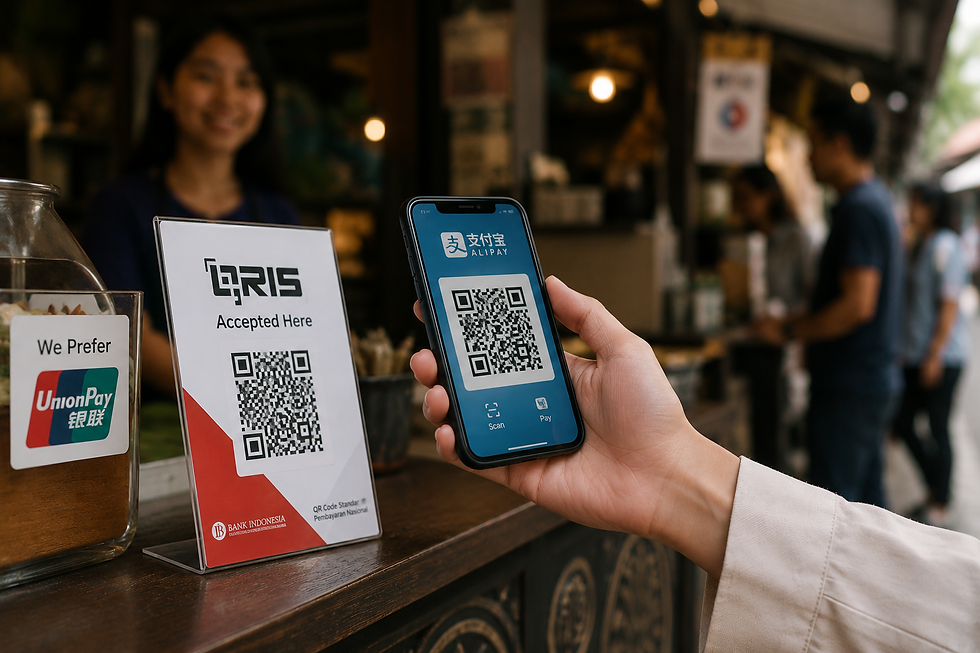
In ASEAN, Bank Indonesia and the People's Bank of China completed a soft launch of direct QRIS-to-Alipay and UnionPay QR connectivity on 11 June, following nearly a year of sandbox testing that began in August 2025. The connectivity allows Indonesian merchants using the national QRIS standard to accept payments from Chinese visitors paying through Alipay or UnionPay, and lets Indonesian travellers pay Chinese merchants directly from their local accounts, without needing separate currency exchange or foreign payment apps. During the sandboxing phase, the corridor processed 1.64 million inbound transactions worth more than 550 billion Indonesian rupiah, alongside a smaller volume of outbound transactions from Indonesian users spending in China.
The launch sits inside a larger regional push. Indonesia officially joined the broader ASEAN and cross-border Regional Payment Connectivity framework in February 2026, following earlier integrations by the Philippines, Malaysia, Singapore, Thailand and Cambodia, all working toward interoperable QR payments that clear directly against local currencies rather than routing through informal exchange networks. Singapore hosts Nexus Global Payments, the non-profit entity coordinating much of this multilateral infrastructure, with a joint venture between Malaysia's PayNet and Singapore's NETS awarded the core technical operator contract in February to build the underlying cross-border processing infrastructure aiming for sub-60-second settlement across jurisdictions.
Why it matters: Cross-border QR connectivity between Indonesia and China plugs one of the region's largest tourism and trade corridors directly into real-time retail payment rails, reducing dependence on cash, informal money changers and costly card network fees for millions of small transactions. As similar links come online between other ASEAN markets and their largest trading partners, merchants across the region will increasingly need to support a growing patchwork of interoperable QR standards rather than a single dominant rail. Expect similar bilateral QR connectivity announcements from Thailand, Vietnam and the Philippines with their largest source markets over the coming year.
The Debia angle: This is precisely the kind of infrastructure story that matters more than it looks on the surface. ASEAN's cross-border payment future is being built corridor by corridor, QR standard by QR standard, and the merchants who benefit most will be the ones whose payment infrastructure can absorb new corridors as they go live without needing a separate integration each time. That is exactly the orchestration challenge Debia is built to solve for merchants and partners operating across Southeast Asia's rapidly interconnecting payment landscape.
At Debia, we track these changes because the future of payments will be shaped by speed, trust, interoperability, and smarter financial infrastructure. We do not just process payments. We understand the infrastructure, regulation, technology, and market shifts behind the future of digital commerce, and we build for where the ecosystem is heading next.


Comments