Finance Is Being Redrawn: AI Agent Banking, Scapia's $63M Round and the ASEAN Payments Alliance
- Pedro Garcia

- 1 day ago
- 5 min read
Today’s stories share a quiet but important pattern: the customers, the rails, and the institutions of finance are all being redrawn at once. A startup is asking US regulators to charter a bank built for AI agents, an Indian fintech is winning capital by designing around the way younger consumers actually spend, and two ASEAN central banks are tightening their alliance on payments. Here is what is happening, and why it matters for merchants, partners, and financial institutions.
Catena Labs Applies for a US Bank Charter Built for AI Agents

Catena Labs, the agentic finance startup founded by Circle co-founder Sean Neville, has raised a 30 million dollar Series A co-led by a16z crypto and Acrew Capital, bringing total funding to 48 million dollars. The headline-grabbing part is not the cheque, but the regulatory move alongside it: Catena has been accepted for filing a national trust bank charter with the US Office of the Comptroller of the Currency. If approved, the company would become a chartered financial institution purpose-built to hold customer funds and process payments on behalf of AI agents, rather than a fintech riding on partner-bank rails.
Catena’s platform is designed around the idea that software actors need their own kind of guardrails. It lets people set spending limits, define approved recipients, cap account holdings, and establish audit trails before handing financial execution off to an AI agent, while staying compliant with frameworks such as the GENIUS Act for payment stablecoins. The move slots into a wider wave: Coinbase launched the first wallet purpose-built for autonomous AI agents in February, and OKX followed with an agent payments protocol in April. The race is now on to define the regulated financial institutions that will sit behind agentic money movement.
Why it matters: Today’s banking, identity, and compliance frameworks were designed for human and corporate customers, not for software agents acting on their behalf. If a trust bank can be chartered specifically to serve AI agents, with rules for spending controls, custody, and recordkeeping built in from day one, that creates a far cleaner home for agentic commerce than bolting it onto existing accounts. Expect more applications of this shape, and a meaningful tightening between AI assistants, stablecoins, and regulated payment rails.
The Debia angle: Whatever you make of agentic commerce, the durable lesson here is that regulation is becoming part of the product, not a wrapper around it. New types of customers, software in this case, are surfacing new questions about identity, authority, and accountability that the payment industry will have to answer. Debia’s focus on infrastructure, controls, and clear rules of engagement is the same instinct: making sure that as the cast of who can pay expands, the trust framework underneath expands with it.
Scapia’s 63 million dollar round shows capital still flows to behaviour-led fintech

In India, Bengaluru-based travel-fintech Scapia has raised 63 million dollars in a round led by US venture firm General Catalyst, with continued backing from Peak XV Partners and Z47. The deal lifts total equity funding to roughly 135 million dollars and assigns the four-year-old company a post-money valuation of more than 500 million dollars, more than double its level from April 2025. It lands at a time when Indian fintech funding has been flat and global investors have become more selective, which makes a 500 million mark for a travel-focused player especially striking.
Scapia’s product fuses things that have traditionally lived in separate apps: co-branded credit cards with Federal Bank and BOBCARD, UPI-based payments through a Scapia Pay rewards experience, travel bookings, a merchant store, and experiences. Flight bookings have grown five to six times year on year and stay bookings eightfold, with rising contribution from tier-two and tier-three cities. The thesis the investors are buying is that India’s next consumer fintech winners will not be digital copies of older banking products, but services designed around behaviours, like how young Indians actually plan, spend on, and reward themselves for travel, with UPI as the rail underneath.
Why it matters: Even in a tighter funding climate, capital is flowing into fintechs that build around a real consumer behaviour and a strong domestic payment rail, rather than launching yet another generic neobank. For markets across Asia where real-time rails are already mature, the lesson is that the value has moved up the stack: rewards, context, personalisation, and embedded commerce on top of the rail are where customer relationships are now won.
The Debia angle: This is exactly how we think about merchants and end customers at Debia. The payment is the means, not the end. The businesses that grow are the ones that put the payment inside a journey customers actually care about, whether that is travel, retail, or services, and use a strong local rail to make the experience effortless. As real-time payments become the default across more markets, providers who help merchants design around behaviour, not just transactions, will be the ones who stand out.
Malaysia and Indonesia Sign a Central Bank Payments MoU
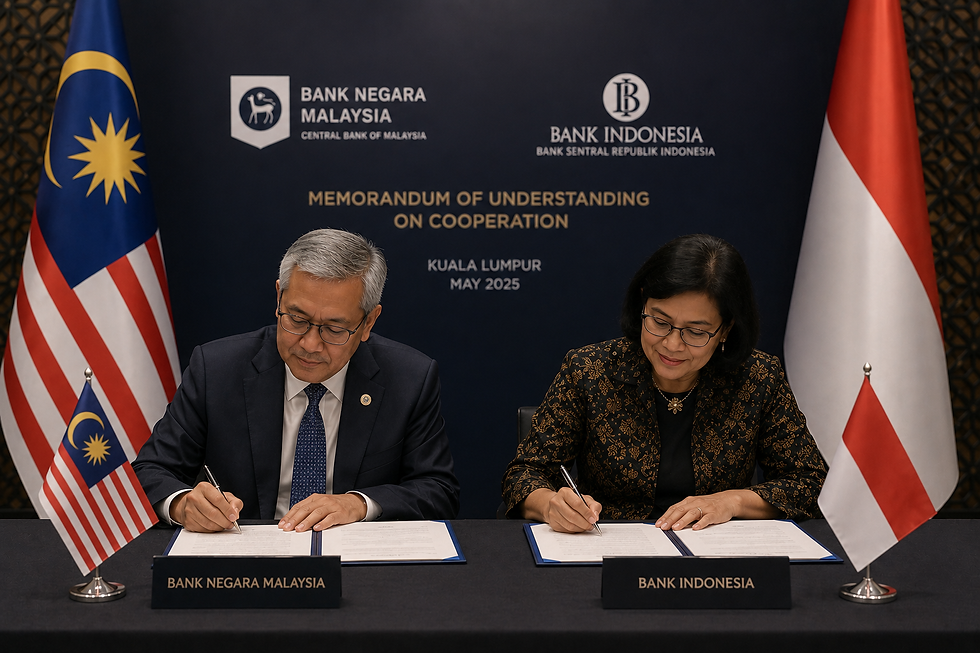
Closer to ASEAN, Bank Negara Malaysia and Bank Indonesia have signed a new memorandum of understanding establishing a broader framework for cooperation across monetary policy, financial stability, macroprudential policy, payment systems and digitalisation, financial sector development, and capacity building. Announced in Jakarta on 11 May, the agreement was framed by both governors as a milestone in deepening institutional ties, with payment systems and digitalisation explicitly flagged as emerging areas of mutual interest.
It is the kind of announcement that does not always grab headlines, but it is the connective tissue behind faster, cheaper regional money movement. It builds on Indonesia’s ongoing work on local currency settlement and a longer regional trend of QR linkages and instant payment system tie-ups between ASEAN economies. As the two largest economies in maritime Southeast Asia, Malaysia and Indonesia, formalising payments cooperation at a central-bank level sets the stage for tighter interoperability between their domestic rails, with potential knock-on effects for fintechs and merchants operating across both markets.
Why it matters: Cross-border payments inside ASEAN have moved a long way in the last few years, but they still rely on a patchwork of bilateral arrangements. Each new central-bank MoU on payments adds a strand to that fabric. For merchants and consumers, the practical benefit shows up as cheaper currency conversion, faster settlement, and more familiar payment experiences when sending or receiving money across borders. The strategic story is the slow building of a regional payments architecture that does not depend solely on global card networks or US correspondent banks.
The Debia angle: Regional interoperability is one of the most important quiet trends in payments, and ASEAN is consistently ahead of the curve on it. The lesson we take is that the future of cross-border payments belongs to providers who can plug into multiple domestic rails as they connect, and offer merchants a single, predictable experience on top. That is exactly the kind of infrastructure Debia is built to support, helping businesses move across borders without being held back by the seams between national systems.
At Debia, we track these changes because the future of payments will be shaped by speed, trust, interoperability, and smarter financial infrastructure. We do not just process payments. We understand the infrastructure, regulation, technology, and market shifts behind the future of digital commerce, and we build for where the ecosystem is heading next.


Comments